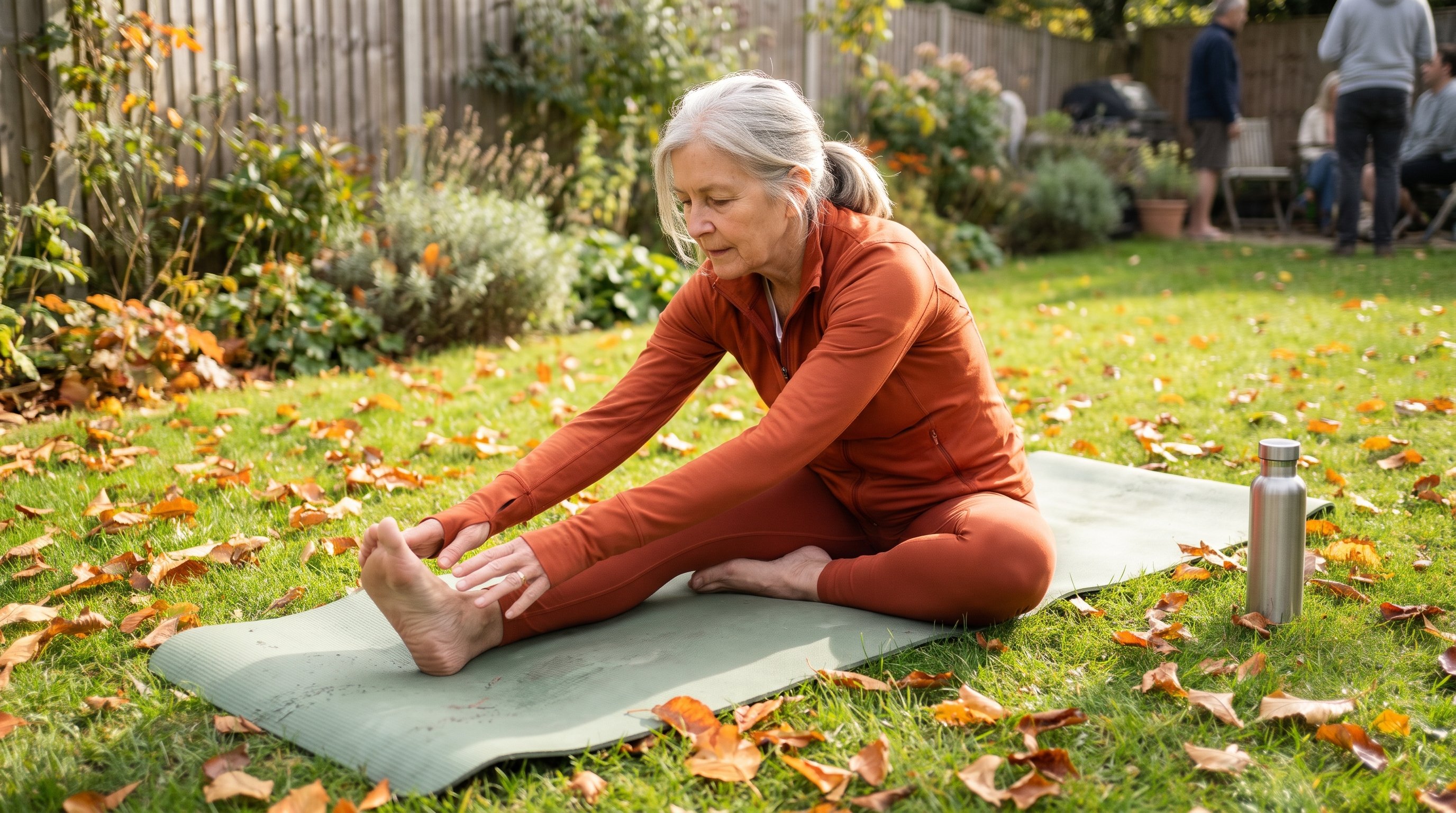
Ankle Mobility Exercises: A Simple Way to Move Freer
By:Author:Flexi Yoga Editorial
Updated on:October 28, 2026

- A Sample Week Built Around Ankle Mobility Exercises
- How Often Ankle Mobility Work Actually Needs to Happen
- Short Daily Ankle Work Beats One Long Weekly Stretch
- Fitting Ankle Mobility Exercises Into a Normal Day
- Adjusting Ankle Mobility Exercises to Different Situations
- What Changes Over Time and Where People Stop
- Building Ankle Mobility Exercises Into a Flexi Yoga Routine
- Making Ankle Care a Normal Part of the Week
Ankle mobility exercises are simple movements that take the ankle joint through its full range, usually circles, rocks and calf stretches done a few times a week. The direct answer: a handful of short sessions, done consistently, tends to matter more than one long stretching push.
The ankle is a hinge plus a bit of rotation, and it tightens up fast when it sits in the same position all day - shoes, chairs, car pedals. Moving it through its available range regularly keeps that range from shrinking further, which is the whole mechanism here.
This article covers what a good week of ankle work looks like, how much is enough, why short sessions beat one big effort, and how to fit the habit into an ordinary schedule.
A Sample Week Built Around Ankle Mobility Exercises
A workable week does not need a gym or any equipment. It mixes standing and seated work across most days, with a rest day or two built in.
Weekly Layout
- Monday - ankle circles both directions, calf raises against a wall, 5 minutes
- Tuesday - rest or a normal walk, no dedicated session
- Wednesday - wall ankle rocks (knee towards wall, heel down), seated alphabet tracing with the foot
- Thursday - standing calf stretch against a step, ankle circles
- Friday - rest or light walking
- Saturday - full routine: circles, rocks, calf raises, calf stretch, 8-10 minutes
- Sunday - rest
How Often Ankle Mobility Work Actually Needs to Happen
There is no need to overthink the dose. Short, frequent sessions are the whole strategy.
A Simple Frequency Guide
The table below gives a starting point based on how stiff the ankles feel day to day.
| Situation | How Often | Session Length |
|---|---|---|
| Mild tightness | 3 times a week | 5 minutes |
| Noticeable stiffness | 4-5 times a week | 5-8 minutes |
| After long sitting | Daily | 3-5 minutes |
| Active or on feet often | 2-3 times a week | 5 minutes |
Short Daily Ankle Work Beats One Long Weekly Stretch
Picture two approaches: five minutes of ankle circles most days, versus one 30-minute stretching session crammed in on a Sunday. The daily version wins, and not because it is more intense - it is because it actually happens.
A joint that gets moved through its range often stays more used to that range. A joint that gets stretched hard once a week and then ignored just goes back to its tight starting point by Wednesday.
The harder alternative - one long session - also asks more of the day. Thirty minutes is easy to skip when life gets busy, but five minutes rarely gets cancelled, which is why it tends to survive a real week.
Fitting Ankle Mobility Exercises Into a Normal Day
Most people do not have a spare half hour for joint care, and ankle work does not need one. Circles and rocks can happen while brushing teeth, waiting for the kettle, or sitting at a desk between calls.

This is where a guided plan helps rather than a vague idea to stretch more. Flexi Yoga builds short, guided sessions around moments like these, so the exercises get attached to a routine that already exists instead of needing a new one.
Attaching the habit to an existing cue - kettle, commute, bedtime - removes the need to remember it as a separate task.
Adjusting Ankle Mobility Exercises to Different Situations
Just Starting Out
Begin with seated ankle circles rather than standing calf stretches, since sitting removes the balance challenge. Small, slow circles count just as much as big ones at this stage.
Desk-Bound and Short on Time
Seated work under the desk - circles, point and flex, drawing letters with the toes - fits between meetings without anyone noticing. A few minutes scattered through the day adds up the same as one block.

Older Adults
A chair or wall nearby for balance support makes standing stretches feel steadier, and holding a stretch a touch longer with less force is a reasonable swap for speed. Seated versions of every move are available if standing feels unstable on a given day.
Active and on Their Feet All Day
People who walk, run or stand for work still benefit from circles and calf stretches, since repetitive motion in one direction does not replace a full range of movement. A short session before or after activity keeps the ankle from settling into one narrow pattern.
What Changes Over Time and Where People Stop
Joint mobility tends to shift gradually rather than overnight, and that gradual pace is normal, not a sign the sessions are not working. Staying vague about exact timing is honest, because joints, starting points and habits all vary too much for a fixed number.
The common drop-off point is the first couple of weeks, right when the new habit still feels optional and nothing dramatic has happened yet. People often stop just before the small gains would have started to feel normal.
Keeping sessions short enough to survive a bad week is the practical fix, since a five-minute habit is far easier to pick back up than a thirty-minute one that fell off the calendar a month ago.
Building Ankle Mobility Exercises Into a Flexi Yoga Routine
Knowing the moves is one thing - remembering to do them on a Tuesday with a full inbox is another. That is the gap a structured plan is built to close.
Flexi Yoga offers a tailored flexibility and mobility plan with short, guided sessions, so ankle work sits alongside the rest of a routine instead of being one more thing to plan from scratch. Daily habit trackers keep an eye on consistency, and the challenges feature turns small, repeated effort into something a bit more engaging.
The article library adds context along the way, so the reasoning behind each session is easy to follow rather than just a list of instructions to get through.

Move Freely Again
Loosen Up Every Day
Making Ankle Care a Normal Part of the Week
These exercises do not need a special time slot, special shoes, or a long block of free time. A few minutes attached to something already happening in the day is enough to keep the habit alive.
The simplest next step is picking one cue - kettle, teeth, desk break - and attaching one short set of circles to it today, then letting Flexi Yoga carry the rest of the plan from there.
FAQ
Moving the ankle through its full range regularly keeps that range more available, which is the main reason stiffness tends to ease with consistent practice. It is not a one-time fix, so the benefit tends to track with how often the sessions happen.
A few minutes done consistently moves the needle more than an occasional long session, since the joint benefits from frequent exposure rather than one intense push. More time is not wasted, but it is not required either.
Circles and calf stretches fit into moments that already exist - brushing teeth, waiting for a kettle, sitting at a desk - so the barrier is usually attaching the habit to a cue, not finding extra time. Flexi Yoga's short guided sessions are built to slot into exactly those gaps.
The early weeks often feel optional because changes are gradual, and that is usually when people quit, right before the routine would have started to feel automatic. Keeping sessions short enough to survive a busy week makes it far easier to pick back up instead of abandoning it.
Share this post